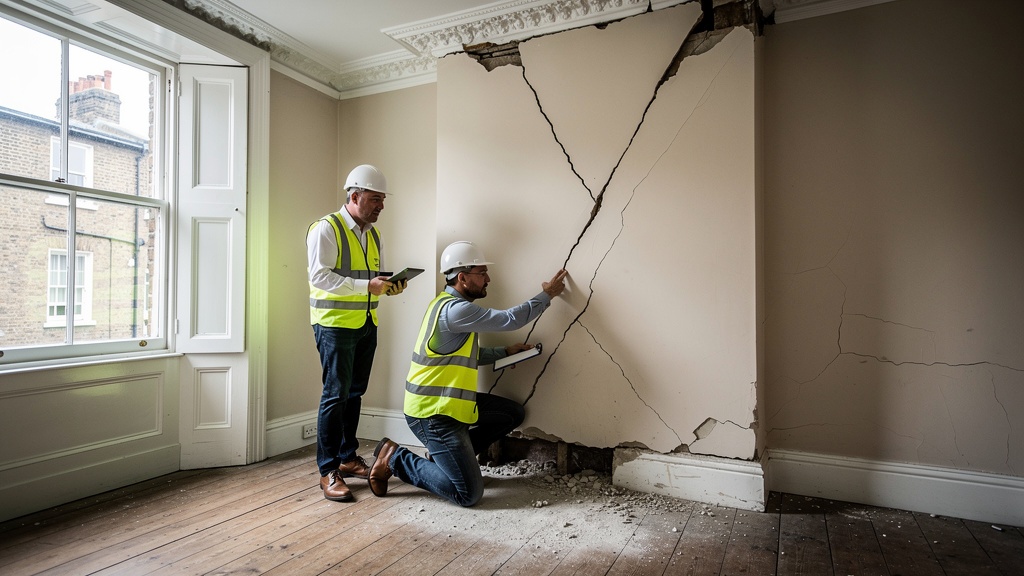
No two building surveys are alike, but certain structural defects come up again and again in South London properties — particularly in Victorian and Edwardian terraces. As a building surveyor at Clapham Surveyors, I've inspected hundreds of properties across Clapham, Balham, Battersea and Brixton. Here are the structural issues buyers most need to understand.
Subsidence and Settlement
Subsidence is the downward movement of the ground beneath a building's foundations — causing the building to sink unevenly. It's one of the most feared words in property, but it's important to distinguish subsidence from settlement:
- Settlement is the gradual compression of soil under a building's weight after construction. It's a normal process and, in older properties, is usually complete and stable.
- Active subsidence is ongoing movement caused by soil shrinkage (usually clay soils drying out, often due to tree roots), ground erosion, or mining/utility works.
South London sits predominantly on London Clay — a soil that shrinks significantly in dry summers and expands in wet winters. This makes the area particularly prone to subsidence, especially where mature trees are close to buildings. The tell-tale signs: diagonal cracks at door and window corners, cracks that are wider at the top than the bottom, and doors or windows that stick or don't close properly.
Wall Tie Failure
Wall tie failure is common in properties built between about 1920 and 1980 using cavity wall construction. Wall ties are metal connectors that hold the inner and outer leaf of a cavity wall together. The original galvanised steel ties used in this period are prone to corrosion over time — when they rust, they expand and force the outer leaf of brickwork to bulge or crack.
Signs: horizontal cracking in brickwork at regular intervals (usually every 450mm — the height of the tie course), bulging or bowing in external walls. Our Level 3 building surveys include a visual assessment for wall tie issues; in some cases we recommend endoscopic investigation to confirm.
Lintel Failure
Lintels are horizontal structural elements spanning door and window openings, carrying the load of the wall above. In Victorian properties, lintels were typically made of timber, brick arches or early steel. Timber lintels are susceptible to rot; brick arches can develop cracks if not maintained; early steel lintels are prone to corrosion.
Signs of lintel failure: cracks radiating from door or window corners, sagging brickwork above openings, doors or windows that are difficult to open or shut. This is a Condition Rating 3 (urgent) item in our Level 2 and Level 3 survey reports.
Chimney and Stack Issues
Victorian properties typically have multiple chimney stacks — often six or more in a terraced street. Years of exposure, differential thermal movement and the removal of original fireplaces all take their toll. Common problems we find include: spalling brickwork, failed pointing (allowing water ingress), leaning or unstable pots, and compromised flaunching (the mortar haunching around the base of the pots).
Inside the property, removed or altered chimney breasts are a significant structural concern — if the stack above is not properly supported after a breast is removed, the consequences can be severe. This is a common finding in Clapham area properties where owners have opened up ground floor layouts. Our Level 3 building surveys always check for this.
Bay Window Movement
Bay windows are one of the most common sources of structural movement in Victorian terraces across the Clapham area. The foundations beneath a bay window are typically shallower than those under the main building, making them more susceptible to seasonal movement. Signs: cracks at the junction between the bay and the main building, and between the bay roof and the main fascia.
In most cases, bay window movement is minor and historic — long since ceased. But active movement needs investigation and potentially underpinning or pinning. Our Level 3 surveys assess this carefully.
A Note on Cracks
Not all cracks are serious. Properties move and crack — that's normal. What matters is: the width, pattern and direction of cracks; whether they're active or historic; and what's causing them. A single, hairline crack above a door is almost certainly settlement. A wide, diagonal crack running from a window corner to the corner of the building, wider at the top, recently active — that's a different matter entirely. Only an experienced surveyor can make this distinction reliably.
What Happens When We Find Structural Defects?
Finding a structural defect in your survey report doesn't necessarily mean you shouldn't buy the property. What it means is that you need:
- A clear explanation of what was found and its likely severity
- Advice on whether further investigation is needed (e.g. a structural engineer)
- Guidance on likely repair costs
- The information you need to negotiate with the seller
At Clapham Surveyors, we provide all of this as standard in every Level 3 building survey. We're also available after the report to talk you through the findings and help you decide what to do next.
Frequently Asked Questions
Yes. A RICS Level 3 building survey includes a detailed structural assessment as one of its core components. The surveyor will identify, describe and advise on any structural defects found. Where specialist structural engineering investigation is recommended, this will be flagged in the report.
Not automatically. Almost all older buildings have experienced some movement. The key question is whether the movement is active or historic. Historic, stable movement is common in Victorian properties and doesn't necessarily affect value or habitability. Active, ongoing movement is more serious and needs investigation. Your surveyor will advise you clearly on which it is.
Active subsidence causing damage is typically covered by buildings insurance, subject to your policy terms and excess. Historic subsidence (where movement has ceased and repairs have been carried out) is normally insurable, but premiums may be higher. You should always declare any known history of subsidence to your insurer.
For a thorough assessment of any structural concerns in a South London property, a Level 3 building survey from Clapham Surveyors is essential. Contact us today for a free, no-obligation quote.
Related reading: Damp in Victorian Houses | Victorian House Survey Checklist