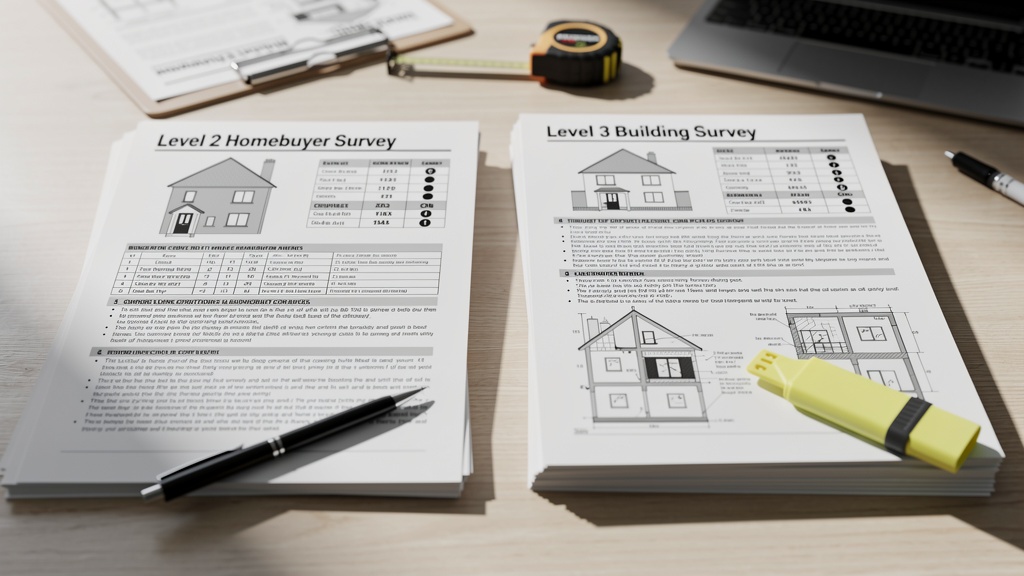
Clapham Surveyors gets asked this question almost every day: "Do I need a Level 2 or a Level 3 survey?" The honest answer is — it depends on the property. But making the wrong choice can either leave you underprotected or, occasionally, paying for more than you need. This guide breaks it down clearly so you can decide with confidence.
What Changed? A Quick History
Before we dive into the differences, a quick note on terminology. Until 2021, the main residential surveys were called the Homebuyer Report (Level 2) and the Building Survey (Level 3). The Royal Institution of Chartered Surveyors (RICS) rebranded these as Level 2 and Level 3 to create a clearer, more consistent framework. You'll still hear the old names used — both by surveyors and clients — but they refer to the same products.
What Is a RICS Level 2 Home Survey?
A RICS Level 2 home survey is a standard visual inspection of a property's accessible and visible elements. It uses a traffic-light condition rating system:
- Condition Rating 1 (Green): No repair currently needed. The property element is in satisfactory condition.
- Condition Rating 2 (Amber): Defects that need repairing or replacing, but are not considered urgent.
- Condition Rating 3 (Red): Defects that are serious or need to be repaired, replaced or investigated urgently.
The report covers the structure, fabric and services of the property — including roof, walls, floors, windows, dampness, heating and drainage. It's written for non-experts, so you don't need a construction degree to understand it.
"When I was buying my first flat in Clapham in 2018, I panicked when I got my Level 2 report back and saw several Condition 2 ratings. My surveyor spent 20 minutes on the phone explaining that most were routine maintenance items, not deal-breakers. That kind of support is invaluable." — Laura B., Clapham North
What Is a RICS Level 3 Building Survey?
A RICS Level 3 building survey is a comprehensive, detailed inspection. It goes significantly further than a Level 2 — the surveyor assesses the construction methods used, investigates accessible areas in more depth (including roof spaces and sub-floor voids), and provides detailed analysis of any significant defects found.
The resulting report is typically much longer and more technically detailed. It explains the likely causes of defects, provides guidance on the urgency and nature of repairs, and may include indicative cost estimates. Where specialist reports (e.g. from a structural engineer or drainage surveyor) are recommended, these are flagged clearly.
The Key Differences at a Glance
| Feature | Level 2 | Level 3 |
|---|---|---|
| Depth of inspection | Standard visual | In-depth structural |
| Access to roof void / sub-floor | ||
| Construction analysis | Limited | Full assessment |
| Defect cause analysis | Brief | Detailed |
| Repair cost guidance | No | Where appropriate |
| Specialist reports flagged | More detailed | |
| Suitable for Victorian properties | Sometimes | Recommended |
| Typical report length | 30–50 pages | 60–100+ pages |
| Typical cost range (Clapham) | From ~£450 | From ~£650 |
When Should You Choose a Level 2?
A Level 2 home survey is right for you if:
- The property was built after approximately 1900
- It's conventionally constructed — no unusual materials or methods
- It appears to be in reasonable condition with no obvious major problems
- It hasn't been significantly altered or extended
- It's a modern flat or apartment in a purpose-built block
Think: a 1970s maisonette near Clapham Junction, a modern flat in Battersea, or an interwar semi in Balham that's been well maintained.
When Should You Choose a Level 3?
A Level 3 building survey is the right choice if:
- The property is Victorian or Edwardian (built before approximately 1919)
- It has had significant alterations, extensions or conversions
- You're planning major renovation or refurbishment works
- The property appears to be in poor or unknown condition
- It's an unusual build — e.g. non-standard construction, listed building
- You simply want the most thorough picture possible
Real-World Case Study
A client came to us planning to buy a beautiful 1890s double-fronted Victorian terrace on a quiet street near Clapham Common. The estate agent suggested a Level 2 would be "sufficient". We advised a Level 3. The survey revealed: historic but active subsidence, a compromised chimney breast that had been partially removed (affecting structural integrity), and asbestos lagging on heating pipes in the basement. The client negotiated £35,000 off the purchase price and had a clear remediation plan before they even moved in. The Level 3 cost just £750.
How Much Do They Cost in Clapham?
Survey costs vary based on property size, value and location. As a rough guide for the Clapham area:
- RICS Level 2 Home Survey: Typically £450–£750 for an average Clapham property
- RICS Level 3 Building Survey: Typically £650–£1,100 for an average Victorian terrace
Always ask for a fixed, all-inclusive quote before committing. At Clapham Surveyors, we never charge hidden extras.
Frequently Asked Questions
Yes, in most cases. If you've booked a Level 2 and then decide you'd prefer a Level 3, contact us as soon as possible. We'll advise on whether it's possible to adjust before the survey date.
Not automatically. Both Level 2 and Level 3 surveys can include a market valuation as an optional add-on. Speak to us when booking if you'd like to include this.
The terms are often used interchangeably, and a Level 3 does include detailed structural assessment. However, if there are specific structural concerns (e.g. suspected subsidence), you may also need a separate report from a structural engineer. We'll flag this in our report if relevant.
Just get in touch. Tell us about the property — its age, construction type and any known issues — and we'll recommend the right survey for you. There's no charge for this advice.
The Bottom Line
For most properties in the Clapham area, a Victorian or Edwardian terrace will benefit significantly from a Level 3 building survey. The extra cost is modest compared to the detailed information you receive — and the potential to negotiate significant savings off the purchase price.
If you're buying a modern, well-maintained flat or a post-war property in reasonable condition, a Level 2 home survey may be perfectly adequate. The key is to get the right advice before you commit.
At Clapham Surveyors, we'll always recommend the survey that's right for your property — not the most expensive option. Get in touch today for a free, no-obligation quote.