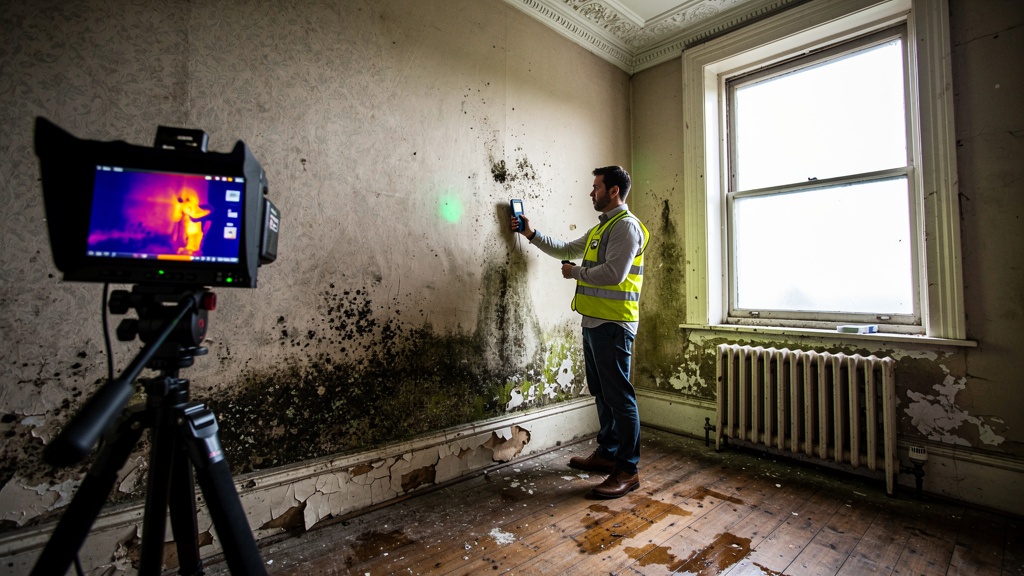
Damp is the word that strikes fear into every property buyer's heart. And in South London — where Victorian and Edwardian terraces dominate the housing stock — it's also one of the most common findings in a building survey. I'm David Marsh, building surveyor at Clapham Surveyors, and in this guide I'll explain the three main types of damp, how to identify them and what you should do if your survey flags it.
The Three Types of Damp
Not all damp is the same. The appropriate remedy — and the cost — varies enormously depending on the type. Confusing them is one of the most common (and expensive) mistakes homeowners make.
1. Rising Damp
Rising damp occurs when groundwater travels upward through a wall's pores by capillary action. It typically affects the lower sections of external walls (usually the bottom metre) and leaves distinctive "tide marks" — a brown or white staining at a consistent height around the room. You may also see salt crystals on the surface of plasterwork as moisture evaporates.
Victorian houses were typically built with a physical damp-proof course (DPC) — usually a layer of slate or bitumen at low level in the wall. When this fails or is bridged (by raised external ground levels or internal floor screed), rising damp can become a problem. In many cases, the apparent "rising damp" is actually penetrating damp or condensation — misdiagnosis here is rife.
2. Penetrating Damp
Penetrating damp occurs when water enters a building through defects in the external fabric — typically failed pointing, cracked render, damaged window sills, defective flashings, blocked gutters or failed flat roof coverings. Unlike rising damp, it can appear at any height, and its location usually points to the source of the problem.
Penetrating damp is extremely common in Victorian properties in the Clapham area, particularly after periods of sustained rainfall. The good news is that it's usually straightforward to repair once the source is identified and fixed.
3. Condensation
Condensation is not strictly a structural defect — it occurs when warm, moisture-laden air meets a cold surface and the moisture turns to liquid. It's the most common form of damp in occupied properties and is most often found in kitchens, bathrooms and poorly ventilated bedrooms.
It can look similar to other forms of damp, but the key indicators are: mould growth (particularly at low level or in corners), no clear external source, and the damp appearing seasonally (worse in winter when heating is on and windows are closed).
How Our Surveys Identify Damp
When our chartered surveyors carry out a Level 3 building survey or Level 2 home survey, we use a range of tools and methods to identify damp:
- Calibrated moisture meters: To measure the moisture content of walls, floors and timbers
- Thermal imaging cameras: To identify cold spots, water tracks and areas of evaporation that may not be visible to the naked eye
- Physical inspection: Checking external fabric, drainage, gutters, roof coverings, pointing and flashings
- Pattern evidence: The shape, location and height of damp staining, salt deposits and mould growth all provide vital diagnostic clues
Case Study: Rising Damp or Condensation?
A client purchasing a first-floor flat in Clapham had received a damp survey from a specialist company quoting £4,500 for chemical injection to treat "rising damp". We were asked to carry out a Level 3 survey and review the findings. Our assessment concluded the issue was almost entirely condensation caused by inadequate ventilation — a common finding in converted Victorian flats. Our recommended fix: improved bathroom extraction and air bricks. Cost: under £300. The client saved over £4,000.
What Should You Do If Your Survey Flags Damp?
First, don't panic. Damp in a Victorian property doesn't automatically mean a disaster. The key questions are:
- What type of damp is it?
- What is the source?
- How severe is it?
- How much will it cost to fix?
In many cases, fixing the source (e.g. repointing, clearing gutters, replacing a window sill) is straightforward and affordable. In more serious cases — particularly where timber rot has occurred — the costs can be more significant. Either way, a detailed report from your surveyor gives you the information you need to negotiate with the seller or make an informed decision about whether to proceed.
For more on using survey findings: How to Read and Use Your Building Survey Report
Frequently Asked Questions
Yes, very. Victorian properties were built before modern damp-proofing standards existed, and over 130+ years of weathering, many have developed some degree of damp. It doesn't make them bad purchases — it just means buyers need to understand what they're dealing with.
Not always. If our Level 3 survey identifies damp and the cause is clear, a specialist damp survey may not add significant value. We'll always tell you if we think one is warranted. Be cautious about specialist damp companies who have a financial incentive to recommend expensive treatments — we provide independent advice.
In severe cases, yes. Prolonged damp can cause wet rot or dry rot in floor joists, roof timbers and staircases — which can be costly to treat. It can also soften plasterwork and accelerate brick deterioration. Early identification and repair is always better than waiting.
The Bottom Line
Damp in a Victorian house is common, but it's not something to ignore or guess at. Getting a thorough survey from experienced local surveyors — who know the typical problems affecting period properties in the Clapham area — is the best protection against an expensive post-completion surprise.
Contact Clapham Surveyors for a free quote on a Level 2 or Level 3 survey. We'll tell you exactly what's going on with your property — clearly, honestly and without jargon.